There’s a tax you pay every working day. It doesn’t show up on any invoice. No accountant will ever flag it. But it’s real, it compounds, and for most entrepreneurs it’s one of the biggest line items in the business — you just can’t see it, because it’s collected in twenty-second increments.
It’s the app-switching tax. And once you learn to notice it, you’ll see it everywhere in your day.
Follow yourself for one morning
Here’s a composite morning that will feel familiar. You sit down to do one thing: send a proposal to a prospect.
- Open email to find their original message. See four new emails. Answer one “quick” one.
- Open the CRM to check the contact’s history. Notice two other deals marked stale. Make a mental note that immediately evaporates.
- Open the calendar to propose meeting times. Notice Thursday is overloaded. Spend two minutes moving a call.
- Open the pricing spreadsheet. Question a number. Open Stripe to check what the last similar client actually paid.
- In Stripe, notice a failed payment. Open WhatsApp to ask the client about it. See three other messages. Reply to two.
- Return to the proposal. Stare at it. What was I about to write?
Elapsed time: fifty minutes. Proposal status: one paragraph. Nothing you did was wrong — every detour was legitimately your job. That’s what makes this tax so effective: it’s collected while you’re behaving responsibly.
What switching actually costs
The research on this is old, consistent, and brutal. Attention doesn’t switch cleanly — part of your mind stays attached to the previous task, something researchers call attention residue (Sophie Leroy, 2009). Getting back into a demanding task after an interruption takes serious time. In Gloria Mark’s 2005 UC Irvine field study, 57% of tasks were interrupted, and people who returned to an interrupted task the same day did so after about 25 minutes on average. (The often-quoted “23 minutes” figure doesn’t appear in her published papers; see what the research on app-switching actually says.) You don’t get interrupted once a day. A 2022 study of 137 workers at three Fortune 500 companies counted nearly 1,200 toggles between apps and websites a day, which added up to just under four hours a week spent reorienting, about 9% of their time at work (Harvard Business Review).
Do conservative math on yourself. Say you switch contexts 30 times a working day — you switch more — and each one costs you just two minutes of refocusing, not twenty-three. That’s an hour a day. Five hours a week. Over 250 hours a year — six full working weeks — spent not on work, but on reloading your own brain.
If a supplier invoiced you for six weeks of nothing every year, you’d fire them by lunch.
The three disguises the tax wears
1. “Just checking”
The five-second glance at the sales dashboard, the store orders, the channel stats. The glance is five seconds; the recovery isn’t. And because each dashboard lives in its own app with its own login, checking three numbers means three full context switches. The information was worth having. The route to it is what’s robbing you.
2. The pinball effect
You saw it in the morning story: each app you open shows you its pending work. Email shows unread. CRM shows stale deals. WhatsApp shows waiting messages. Every switch exposes you to a new set of hooks, and each hook is another switch. You didn’t lose the morning to one interruption — you lost it to a chain reaction where every app handed you off to the next.
3. The evening fog
The end-of-day feeling of having worked flat out and being unable to name what you finished. That’s not a memory problem. Days shredded into forty fragments don’t consolidate into a sense of progress, because no fragment was long enough to be progress. The tax isn’t just hours — it’s the coherence of the hours you keep.
Why the productivity advice keeps failing you
You’ve read the fixes. Batch your email. Time-block. Turn off notifications. Deep work hours. All fine advice, all treating the same symptom: too many interruptions.
But look at the morning story again. Almost none of it was notifications. You pulled every one of those switches yourself, because the information you needed was legitimately scattered across six systems. Discipline can stop you checking Twitter. Discipline cannot un-scatter your business. As long as revenue lives in one app, clients in another, and schedule in a third, assembling a full picture requires the tour. The tax isn’t a habit. It’s an architecture.
Fixing the architecture instead
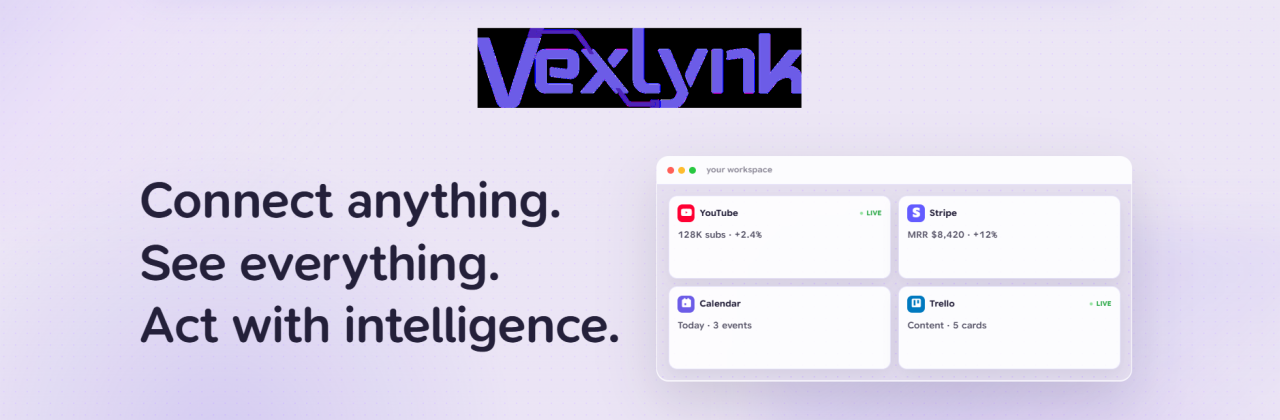
This is the specific problem Vexlynk exists to remove. Not another app in the rotation — the place where the rotation stops.
Your sources — Stripe, Shopify, Google Calendar, your CRM, WhatsApp, your content channels — connect once, and each becomes a live card in one spatial workspace. The morning tour of six apps becomes one glance at one canvas where everything is already current, already side by side, already yours.
Walk the morning story back through it. Proposal time: the client’s history, your calendar, the pricing sheet, and your recent payments are cards on the same screen. No tour. No pinball. Revenue and the latest payments are visible without opening Stripe — and you can ask the built-in AI agent, which reads your actual cards, “anything urgent before I start?” and get an answer grounded in your real data instead of touring six apps to find out.
The switching tax doesn’t fall to zero — some tools you’ll always open directly, and deep work in a specific app is still deep work. What disappears is the observation tax: the dozens of daily switches whose only purpose was to look at a number. Those become one workspace, checked once, trusted all day.
Measure your own tax rate
Don’t take the composite morning’s word for it. Tomorrow, keep a tally — a sticky note with a mark for every time you switch apps to check something rather than to make something. No judgment, just marks.
Most people quit counting before lunch, around mark thirty, mildly horrified. Multiply your count by two minutes and by 250 working days, and you’ll know your personal annual tax bill.
Put a dollar figure on it
Hours are easy to shrug off. A business owner decides with money, so turn the tally into a line item. You need three numbers, and all of them are yours:
- Observation switches per day. From your tally: only the trips to check something.
- Minutes lost per switch. Use two if you have nothing better. That is an assumption, not a research result: the best direct measurement, the 2022 HBR study, only timed the visible reorientation (a little over two seconds per switch), and it still reached nearly four hours a week because the switches were so frequent. Adjust the two minutes to what you notice in yourself.
- What one of your hours is worth. The rate you’d bill a client, or what you’d pay someone to cover that hour.
Annual cost = switches per day × minutes per switch ÷ 60 × working days × hourly value. Here is the arithmetic with the post’s own conservative numbers and two example hourly values (pick your own):
| Observation switches a day | Minutes each | Hours a year (250 days) | At $50 an hour | At $100 an hour |
|---|---|---|---|---|
| 15 | 2 | 125 | $6,250 | $12,500 |
| 30 | 2 | 250 | $12,500 | $25,000 |
| 45 | 2 | 375 | $18,750 | $37,500 |
Now put that figure next to your monthly software bill. If the switching cost is the bigger line, cancelling an app won’t fix it; cutting trips will. And the formula still undercounts, because it prices every minute the same, when the switches that hurt most land in your best hours (more on that below).
For who measured what, with sample sizes and caveats, see what the research on app-switching actually says. For the step-by-step fix, see how to stop checking your business across 20 apps.
Links checked September 28, 2026.
The switches you should keep
Before this reads as “all switching is bad,” it’s worth drawing the line properly, because two kinds of switching get conflated and only one of them is a tax.
Productive switching is moving between making tools because the work demands it: from the design file to the code editor, from the draft to the research.
The context travels with you — you’re the same project in a different room. This costs little, because your head never left the task.
Observation switching is leaving the task entirely to go look at something: a number, a message count, a booking. The context does not travel. You exit the proposal, become a person reading Stripe, and then have to become the proposal-writer again. This is the taxed kind — and the insidious part is that it looks identical to work. You were, after all, checking on the business.
The tally exercise from earlier gets sharper with this lens: mark only the observation switches. Those are the removable ones. Nobody should feel guilty about switching from the invoice to the contract — that’s Tuesday. The tax is the fourteen trips to dashboards that had nothing new to say.
Why your best hours go first
One more mechanism worth naming, because it explains why the tax hurts more than the hour count suggests: switching costs are not charged evenly across your day.
Complex work — pricing the new offer, writing the difficult email, deciding the quarter’s bet — requires loading a large mental model and holding it. That loading takes your best, freshest attention, which is why you do hard things in the morning. And it’s precisely that loaded state that an observation switch destroys. The interruption doesn’t cost you two average minutes; it costs you two minutes plus the demolition of a structure that took twenty to build and can only be rebuilt while you’re still fresh.
This is why the founder who “only checked a few dashboards” at 9:15 finds themselves doing shallow work by 11: the deep-work window wasn’t shortened, it was shattered. Protecting two morning hours from observation switching is worth more than protecting the entire afternoon — the afternoon was never going to hold the cathedral anyway.
A one-week weaning protocol
If the tally horrified you, here’s the practical sequence — with or without new software:
- Days 1–2: name your checks. List every number you looked at more than once per day. Revenue, orders, views, messages, bookings. This list is usually shorter than the switching suggests — most people guard five to eight numbers with thirty visits.
- Days 3–4: give the checks one home. Put every number from the list on one surface. In Vexlynk that’s connecting each one as a live card — payments, store, calendar, channel — onto one canvas. The point is singular: there is now exactly one place where checking happens.
- Day 5 onward: schedule the glance. Two looks a day — morning and after lunch — at the one surface. Between glances, the deal you make with yourself is simple: anything that needs faster attention will still be there, and if something truly can’t wait, ask the agent “anything urgent?” once instead of touring six apps. One question, one answer, back to work.
The protocol works because it doesn’t fight the urge to know — it satisfies it more cheaply. You still get the reassurance. You stop paying six weeks a year for it.
Then decide whether it’s worth a free account to stop paying it. Vexlynk starts at $0 — one workspace, your sources connected live, and an AI agent reading them so you don’t have to make the rounds. The tour was never the job. It just moved in next to the job, and started charging rent.
Vexlynk
Vexlynk Team