Miro is a canvas for what you think. Vexlynk is a canvas for what’s happening.
That one line is the whole difference — and if you’ve ever run a Miro retro or mapped a customer journey across a wall of stickies, you already believe the premise underneath both tools: that spatial arrangement, this next to that, this cluster over here, is how humans actually think.
Of every tool it gets compared to, Miro is Vexlynk’s closest visual cousin. Both are infinite, zoomable canvases. Both bet on the same idea. The difference is what lives on the board.
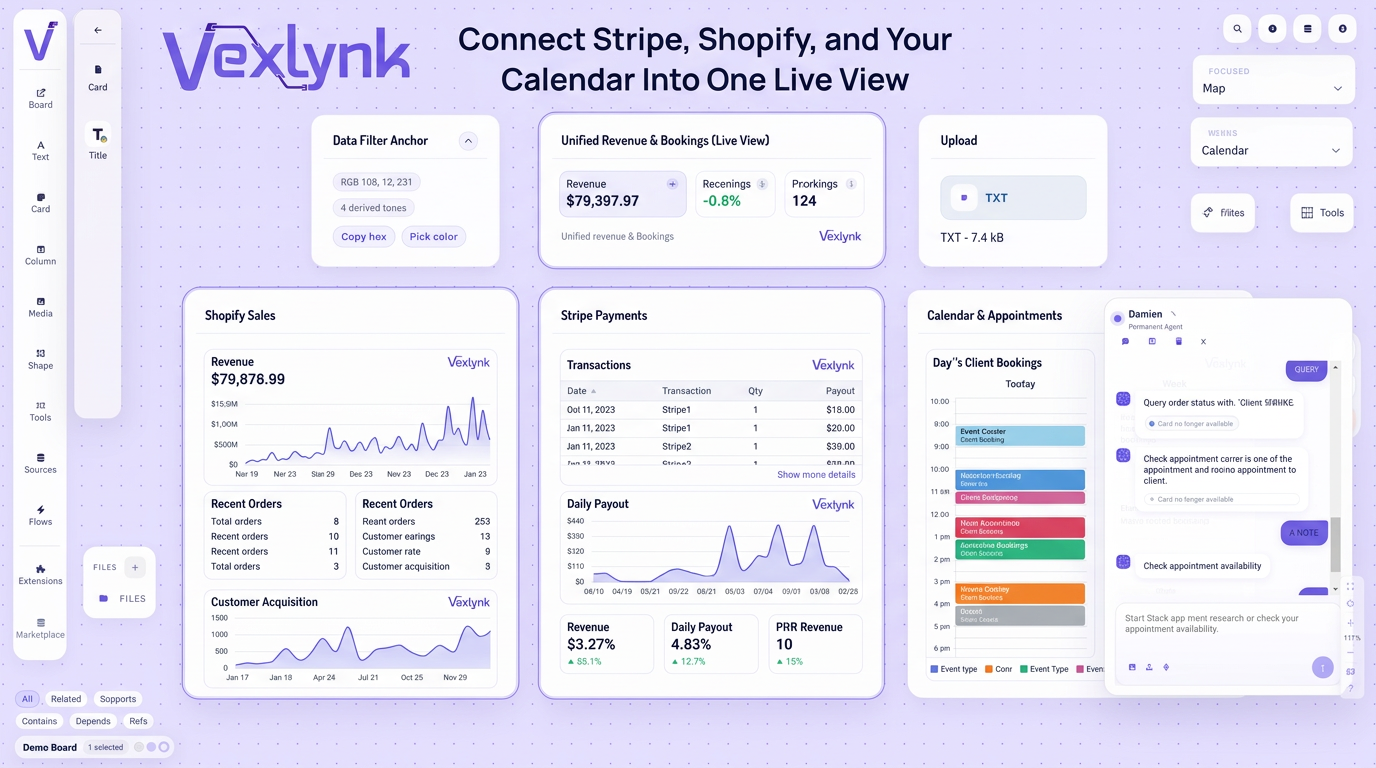
Frozen thought
A Miro board is made of things people put there: stickies, shapes, frames, diagrams. It’s brilliant for workshops, brainstorms, and mapping — moments when the content is the team’s thinking.
But that board is frozen thought.
The sticky that says “revenue ~$8k MRR” was true the afternoon of the workshop. It’s been wrong ever since — and it will never correct itself. Nobody re-stickies reality every Monday.
The cards on a Vexlynk board are alive
Your Stripe card shows today’s revenue. Your GA4 card shows this week’s traffic. Your YouTube analytics, your Shopify orders, your WhatsApp conversations — 23 live sources, each a card that refreshes on its own.
Same spatial grammar as Miro. Completely different substance.
You’re not arranging notes about the business. You’re arranging the business.
What a canvas can do when the cards are live
Spatial thinking plus live data produces something neither can alone: the layout becomes an always-current model of your operation.
Put the campaign card next to the traffic card next to the revenue card. Glance along the row and you see the funnel — today, not last quarter.
Now add a persistent AI agent that has read every card. The canvas starts answering questions. “Bookings up, revenue flat — where’s the leak?” spans three sources and takes one sentence to ask.
And twelve built-in Vlynks — Morning Brief, ROI & Break-even, Client Health — run from their card, when you ask the agent, or on a daily or weekly schedule you set, and surface what changed.
Two authors, not one
Here’s the part Miro structurally can’t copy: the agent doesn’t just read the board. It creates on it — notes, to-dos, summaries, whole board layouts, documents, images, drafted straight into built-in editors.
On a Miro board, every object was placed by a person.
On Vexlynk, the canvas has two authors: you, and an agent that knows your numbers.
What Miro does better
Being honest about this is the whole point — because for what Miro is built for, it’s excellent, and Vexlynk doesn’t pretend to compete:
- Workshops and facilitation. Voting, timers, templates, dozens of live cursors in one retro. Real-time group facilitation is Miro’s crown.
- Diagramming. Flowcharts, service blueprints, architecture sketches with a mature shape library.
- Big-team ideation. When forty people need to think on one surface at once.
- Templates. Miroverse holds more than 7,000 Miro and community templates for retros, journey maps, roadmaps and workshops.
- Integrations and AI around team work. Miro lists 250+ integrations (Microsoft, Slack, Google, Atlassian and more), two-way sync with Jira, Asana, Linear and ClickUp on the Business plan, and Miro AI: diagram, table and summary generation, AI workflows and agents, and an MCP server for tools like Claude, Cursor and Copilot.
If that’s the job, use Miro. It’s the right tool.
Does Miro’s AI see your numbers?
Miro’s closest move toward “seeing the business” is Miro Connectors, which bring context such as Slack threads, Jira tickets, dashboards and meeting transcripts into Miro AI’s Sidekicks and Flows. That’s a real step toward a board that knows more than its stickies. What Miro’s connectors, integrations and pricing pages describe is team knowledge and project work. None of them lists Stripe revenue, GA4 traffic or Shopify orders as a card that keeps itself current on the board, and that’s the gap Vexlynk is built for.
What only Vexlynk does
| Miro | Vexlynk | |
|---|---|---|
| What’s on the board | Ideas you place | Live business data |
| Freshness | Frozen at last edit | Refreshes on its own |
| Authors | People only | You + an AI agent that reads your numbers |
| Intelligence | Miro AI over board content, plus connectors for Slack, Jira and similar team tools | Reasons across your real sources |
| Where it lives | Cloud, team-first | Local-first on desktop; sync and BYOK optional (Plus/Pro) |
| Connects to | 250+ integrations for team tools (Microsoft, Slack, Google, Atlassian) | 23 live sources: Stripe, GA4, Shopify, YouTube, WhatsApp and more |
| Starting price | Free (3 editable boards); Starter $8 and Business $20 per member/month, billed yearly; Enterprise custom | Free (1 workspace, 5 sources); Plus and Pro: see current pricing |
| Best for | The workshop | The board you run the business on |
Miro’s paid plans are priced per member and include AI credits: 25 per member per month on Starter and 50 on Business, with Enterprise from 30 members (Miro pricing). Vexlynk’s Free plan includes 50 AI turns a month; Plus adds cloud sync and 250 AI turns (Vexlynk pricing). Prices as of September 2026.
Do they work together?
Not directly. Miro isn’t one of Vexlynk’s live sources, so a Miro board can’t show up as a card. The one place they can meet is a tool both touch: if your team syncs Miro work items to ClickUp (two-way sync is on Miro’s Business plan), those tasks also appear on a Vexlynk ClickUp card. Most people will simply keep both, each for its own job: Miro for the workshop, Vexlynk for the morning check.
Links and prices checked September 27, 2026.
The bottom line
Keep Miro for the workshop — the messy, wonderful, forty-cursor kind of thinking. It earns its place there.
But the board you open every morning to actually run the business shouldn’t be made of frozen thought. It should be made of the business itself: the numbers, live, already on the canvas.
That’s Vexlynk — the canvas you already believe in, with the data already on it. Local-first on the desktop app, so your boards stay on your machine. Free to start.
So here’s the real question: when you look at your business tomorrow morning, do you want to look at what someone typed last week — or at what’s actually happening right now?
Vexlynk
Vexlynk Team